Year 8

The story of the 2013-14 school year (“Season 7”), and this blog’s original raison d’être.

Shifting to a higher gear

gearshift-large

Back in August sometime, I made a promise to myself that for the 2013-14 school year, I would spend as little time as possible outside of 8-5 working on school-related stuff. 1 Why? Because after pushing full throttle for the first seven-and-a-half, I knew the frantic pace of ’07 – ’13 was perhaps unsustainable.

(this is year 8, sideways or otherwise)

Well, you know what they say about plans.

After being able to go on relative cruise control from August to January, things have ramped up significantly — in terms of required prep, revising curriculum, grading exams, tweaking assessments,2 staying extra-late for tutorials… the list goes on.3

But past experience tells me that this is appropriate for the season.

Past experience also tells me that it doesn’t ramp down much until May 9.4

On the bright side, we did manage to save the globes.

save-the-globes

Twice in the next week or so, the guy at HEB is going to help me check out with a dozen or so packs of chocolate chip cookies.5 And he’s just going to chuckle, because he’ll just know:

It’s that time of the year.6

  1. Yes, of course, if you’re a teacher, you know: This is damn near impossible. But you’ve gotta set the bar somewhere. []
  2. and tweaking REassessments []
  3. Add “eat” and “use restroom” to that list, and that was my life today from 7am to 8pm []
  4. AP Exam Day []
  5. of various brands, of course. []
  6. Inferences with Means, of course []

There’s no crying in Algebra

The single worst day of my teaching career?

It was four years ago this Friday.1

Valentine’s day weekend.

The last day of the 4th six weeks.

The day of the rational functions test in Pre-AP Algebra II.

. . .

Here’s a near-absolute truth about any math class on Earth:

The 4th six weeks is the hardest.

I estimate that some of it has to do with the fact that it immediately follows Winter Break2 and that it takes kids — like adults — some time for their brain functions to defrost.

But of all the math classes that I have taught3 the January-through-mid-February stretch of Algebra II was the toughest.4

2009-20105 was my third year of teaching Pre-AP Algebra II6 and great efforts were made each successive year to refine the course to perfection. But the end of the 4th six weeks that year was one of those “we’re trying to squeeze more juice out of the orange and there’s no more juice to be squeezed out” moments.

Here’s the short version: I can’t deal with crying students. 7

That afternoon, a parade of my Pre-AP Algebra II students came by after school to see their tests,8 and no fewer than 3 of them break down in tears on the spot.9

For any prospective teachers out there: That is NOT the way you want to go home on a Friday afternoon.

. . .

I still to this day remember distinctly when one of the kids saw the 50-something on her paper,10 looked up at me in tears11 and managed to stammer,

That’s IT. I give up. I can’t do this anymore.

And then she walked out. 12

Then I looked to my left and right, and there were yet two other kids that were crying. One of them had to leave for the ladies’ room to compose herself, then came back to look over her exam. 13

I realized then that sometimes, more than anything, our students really just want to hear us tell them that they’re doing things right.

As adults, when the cracks start to show, teachers sometimes have responsibilities that go outside of simply being instructors of the academics.

Sometimes I’m surprised by the degree to which some of these kids are afraid to disappoint us.14 For any figure of authority, the art of being able to strike the right balance between pushing too hard and not pushing hard enough is an impossibly difficult tightrope act. I don’t know how parents manage it. 15

. . .

After a tumultuous three-week stretch peppered with ice days (sans any real ice), AP Stat finally makes the transition from proportions to means this next week. There are only two more major exams this year. That kinda blows my mind to think that things have flown by so quickly.

On the horizon: Chocolate chips per cookie and flying frogs.

  1. which in 2010, was February 12. []
  2. combined with the fact that January is when the toughest material of any math course comes to bear []
  3. to date: Algebra I, Geometry, Regular Algebra II Pre-AP Algebra II, Precal, Stat, and AP Stat []
  4. The on-level course used to include the rational root theorem and the hellish innards of higher-order polynomial functions, while the Pre-AP flavor encompassed logarithms and rational functions — which included slant and parabolic asymptotes that year. []
  5. or “season 3”, as I like to refer to it []
  6. it was also my last []
  7. Funny story? The very first time I had to deal with a crying kid was my 2nd year of — again — Pre-AP Algebra II. Kid came in with her mom to see her first test of the year, and she immediately broke down sobbing and weeping. I actually tried explaining domain and range to her while she was choking on her tears, it was REALLY awkward. That moment scarred me. Scarred me for years. Well a year or so later, I ran into that same student and brought that up, and she said to me, “Oh yeah. I only cried so that I wouldn’t get in trouble with my mom.” -_- []
  8. which, to be honest, was maybe a bit more difficult than was intended. We actually posted a note about a re-test on home access for the following Monday morning before school, and I personally had about 25 of my students show up for it []
  9. and maybe another one or two that suddenly ran out of the room as quickly as possible to cry outside []
  10. which caused her to fail the six weeks []
  11. and for context, this was not a kid that I would classify as remotely overly-emotional []
  12. She came back on Monday morning after meeting with her tutor, and passed the re-test. Which I’m thankful for because at that moment on Friday, *I* almost wanted to cry. It was bad. []
  13. Apparently she called her mother to vent/cry, and two years later at open house, her mother shared with me about that conversation… I won’t go into all of the details but it was a heart-warming moment. []
  14. On the flip-side, we also have students that act like they couldn’t give a flip WHO they disappoint. Sigh. []
  15. A part of me hates that that was the last time I got to teach Pre-AP Algebra II. But I did get another year with many of those students in Precal the next year, and again in AP Stat the year after that []

Finally catch a break

Today at around 4pm, the announcement came over the intercom that the district agreed to extend the end of the six weeks by a week.

Simultaneously, I heard a faint chorus of angels singing “Hallelujah”.

Now instead of frantically trying to figure out how to make up for 3 ice days between now and Valentine’s Day,12 we now have until the end of next week to fit in our 2nd major exam of the six weeks. 3

While it was great to finally catch a break, in a way it’s analogous to raising the debt ceiling4 — great in the interim, but something that we will have to “pay back” eventually. By that, I mean:

  1. Spring Break still begins on March 7, and…
  2. the Statistics AP Exam is still May 9.

It’s not like either of those “hard deadlines” is getting pushed back.

. . .

This morning when it became obvious that school would start 2 hours late today,5 I was fearing that I would have to toss two of my favorite activities overboard: Globe-tossing and flying frogs,6 but it looks as though I’ll at least be able to save the latter.

IMG_0330

  1. which is, by the way, in 3 calendar days. In other words: Impossible. []
  2. also something which, by the way, I had to explain to students is something that I do not celebrate -_- []
  3. If you’re not familiar with “the system” and are wondering why we need to fit in 2 major exams each six weeks, that is a whole other discussion that perhaps I’ll tackle another day. []
  4. oh did that happen today? []
  5. which made it 3-and-a-half “A-days” in 3 weeks []
  6. which, by the way, would really really suck — let’s face it, any student remembers those activities a lot longer than any textbook concept. []

Type I Error

Tomorrow morning, our district is starting 2 hours late as a precautionary measure due to freezing weather.

Even though there is zero chance of precipitation.

Over-compensating? Perhaps. 1

Now, I always build a few days into the calendar that are “semi-fluff” days that can be tossed overboard in case of emergency,2 but… this is starting to cut into the white meat, so to speak.

alpha

Our principal was in my 3rd period class today34 as I was teaching type I and type II errors in hypothesis testing. This would decidedly be the former.

  1. Probably. Almost definitely. []
  2. I had 2 in this unit — fortuitously, I might add — and one in the next []
  3. for my formal observation []
  4. which, by the way. About formal observations… now that I am in year 8, I don’t feel nearly as much anxiety about being observed/evaluated as I once did. But it did take until about this point in my career to develop that level of comfort. []

Open mouth, insert foot

In my seven-and-a-half years of teaching, I have tried very hard to avoid any serious “foot-in-mouth” moments,1 but this past Thursday, as I was introducing my student teacher to my 2nd period Geometry class, I had one.

See, I was explaining to my students that my student teacher effectively has full authority in the classroom now, and that if they wanted to use the restroom or get a drink of water, they would have to ask her, and not me.

Well, one kid asked, “Mister Youn, if we ask her and she says ‘no’, then can we ask you?” 2

So I replied, “Okay, this is NOT like at home, where you ask one parent, and if they say ‘no’ then you go and ask the OTHER parent the same thing.” 3

foot_in_mouth_tim_parkinson
{insert whooshing sound of foot flying in from nowhere and landing swiftly in my mouth}

The next ten seconds sounded something like:

“Well GEE I didn’t have that option when I was growing up.”

“Yeah, neither did I.”

“Seriously, what second parent?”

Sigh. :(

. . .

Between snow days4 and allergy days5 we may have well spent this entire last week in AP Stat playing cards and hopscotch.

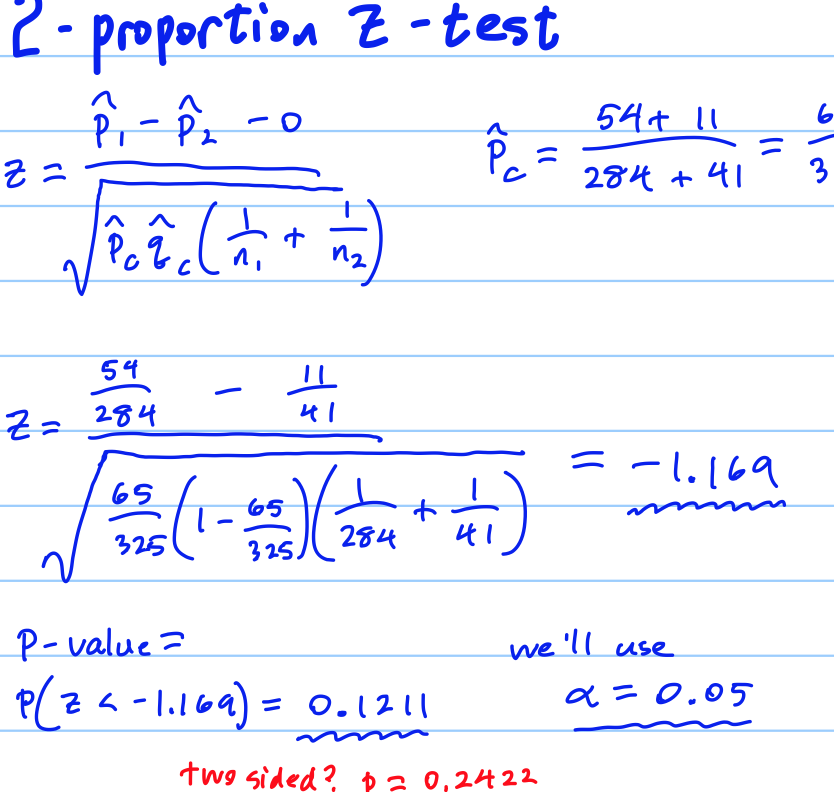
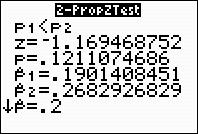
My A-day classes have yet to begin hypothesis testing, and in order to get back on schedule, it looks as if I may have to teach 2-sample procedures without teaching students the formulas.6

2-prop-z-test-calculation

I’ve taught all of the inference formulas every year thus far,7 but once we start preparing for the AP exam, many teachers8 instruct their students to skip them and just use the calculator to get the answer.9

2-prop-z-test-calculator

This has been one of the more frequently mentioned concerns on my end-of-year feedback forms (“if we don’t need to know the inference formulas, why do we waste so much time learning them?!” etc etc), and over the course of the past year or so, I’ve begun to ask myself the same thing.10 Hopefully everything will turn out just fine and we’ll have these ice days to thank for helping us to turn a new page.

  1. you know, when you say something that you immediately wish you could “un-speak”… []
  2. perhaps you see where this is going… []
  3. raise your hand if you saw that coming, and NOW see where this is going… []
  4. which, by the way, lacked any semblance of actual snow []
  5. pretty much every day here in Austin []
  6. and to just perform the hypothesis tests on their graphing calculators []
  7. and with 2-sample proportions z-tests, the formulas are one of the worst parts of the course []
  8. myself included []
  9. which is completely acceptable on the Exam []
  10. Perhaps this falls under the category of “teaching things right” vs “teaching to a test”, but I don’t even know about that. []